TTM associates Article
Is Employee Engagement that Important?“To win in a market place you must first win in the workplace’’, Doug Conant former Campbell’s soup CEO once said. Study after study turns up numbers in the range of 70 to 80% of the workforce that’s either not fully engaged or actively disengaged at work, costing companies billions in annual turnover. The impact isn’t just on the individual; the organization loses out in multiple ways. The most obvious is the lost productivity and discretionary effort of those who are doing just what they have to do to get by but actively disengaged employees can also have a negative influence on other employees and push customers away. Turnover, quality, safety, profitability, the list of costs goes on and on. However, just as marketing and product teams have moved beyond customer satisfaction to look at total customer experience, successful companies are refocusing their efforts on improving the entire employee experience. What do 93% of the top 100 Fortune 500 listed companies KNOW that the other 7% don’t? Here are their top 5 secrets… 01. Know Yourself-Know Your EmployeeToday’s business environment requires learning dynamics that promote high employee engagement and Whole Brain Thinking skills that drive results. Leaders Know their employees ” their preferences, skills, expectations and job needs, they know how to encourage their best thinking, they embrace employee diversity, and they recognize and align employee strengths, talents and needs with the organization’s objectives. There’s no one-size-fits-all management approach to engaging and inspiring employees, but Whole Brain® Thinking gives leaders practical tools to diagnose and adjust their approaches as necessary. It makes it easy for them to keep the lines of communication open so employee engagement becomes a daily focus. Not a stop-gap, crisis management issue. If you want an innovative organization, you need to hire, work with, and promote people who make you uncomfortable. You need to understand your own preferences so that you can complement your weaknesses and exploit your strengths. In a cognitively diverse environment, a message sent is not necessarily a message received. Some people respond well to facts, figures, and statistics. Others prefer anecdotes. Still others digest graphic presentations most easily. Information must be delivered in the preferred “language’’ of the recipient.
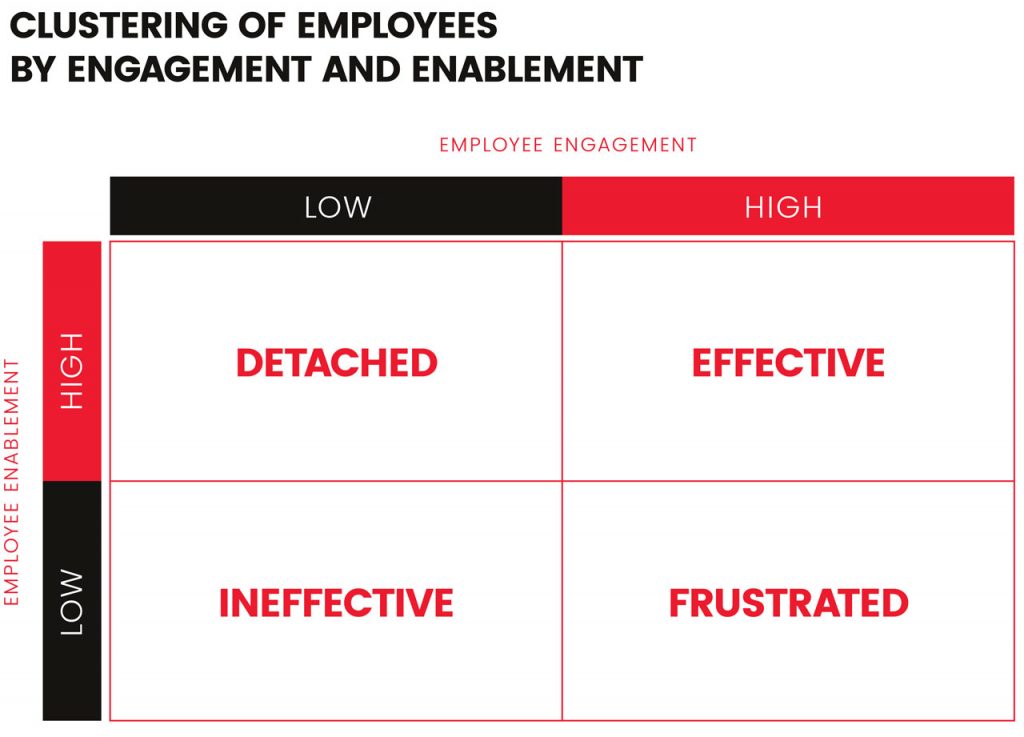
02. Don’t Just Engage… Enable!Employee engagement is only half the story. It’s no good feeling great about your job if you can’t get things done. That’s why it’s important for employees to be “enabled” too. Because if enthusiastic people are held back by bureaucracy, systems or conflicting demands, not only will they underperform – they may stop trying, or even leave. Hay Group Insight has found enabling of employees embraces two key components. The first is an optimized role which requires employees to be effectively matched to their jobs, so that their skills and abilities are effectively utilized. The second is a supportive environment, which provides people with the resources they need (for example, time, information, tools and equipment) and removes barriers from getting the job done (such as red tape, or tasks that don’t add value). By considering both employee engagement and employee enablement, research by Hay Group Insight suggests that there are four distinct groups of employees within a typical organisation. (Figure 1)
03. Inspire and Be Inspired!Truly engaged workplaces are rare. Gallup research shows that worldwide, just 13% of employees are engaged in their jobs -they are involved in, enthusiastic about and committed to their work and workplace. The remaining 87% of employees are either not engaged or indifferent – or even worse, actively disengaged and potentially hostile to their organizations. Southwest Airlines is a company who encourages employees to stay inspired to do things differently, from allowing existing employees from various departments to design their own uniform and giving them autonomy over aspects of their work life they’d never normally get a say in, to becoming a glowing example of customer service due to their collective of happy, committed employees. |

Final ThoughtsImplementing great employee engagement practices is a sure- fire way to improve company culture and have a team full of happy, productive and passionate people! Every business leader worldwide has a responsibility to raise the bar and truly embrace strategies for engagement. This significant step is not only key to improving business outcomes, but is also vital to achieving sustainable growth for companies, communities and countries and for getting the global economy back on track toward a more prosperous future.
|
|
Read more about The Passionate and Collaborative Leader in our Behavioural Leadership section. You are also welcome to read more articles and view our webinars at our Insights Section.
|